Showing posts with label White Mind. Show all posts

Monday, March 28, 2011

We Can Change Our Minds II

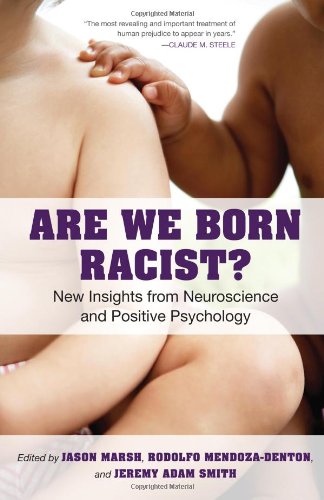
Are We Born Racist? (see intro post) offers further insights into how we can affect the prejudices our brains automatically manufacture.

I've gleaned from the book that there are two sources of implicit bias. I'll call them Sorting (the instantaneous calculations our minds use to place people into in-group - "Us" - and out-group - "Not Us"), and Associations (the cultural messages we absorb.)

Sorting seems to be hardwired into human brains and therefore not a function we can turn off. "Conditioned by millennia of tribal warfare and fierce competition for limited resources, we are always looking for cues to help us make snap judgments about others," Susan Fiske writes in the book's title essay.

But an automatic "Not Us" snap judgment about another person doesn't mean an automatic value judgment; it's just data to the brain. We can consciously direct what our minds do with information that is categorized unconsciously.

"In the neuroscience studies looking at race, ... amygdala (vigilance-related) reactions vary by individual, corresponding to other signs of prejudice... (T)he alarms in whites' amygdalae do not go off to famous black faces. Likewise, their brains grow accustomed to new black faces after repeated exposure," Fiske writes. We can affect the brain's recordings by having more interactions with the people it labels "Not Us."

These interactions can also change our Associations. "Years, even generations, of explicit and implicit cultural messages - gleaned from parents, the media, firsthand experiences, and countless other sources - link particular physical appearances with a host of traits, positive and negative," Fiske reports. It is, it seems to me, another form of hardwiring, often invisible tracks laid down throughout the foundation of society, in our manners and mores, our ideals and our institutions.

Choosing to be vigilant about uncovering what we've internalized - rather than denying that those messages are there because they don't match our intentions or our self-image - is a powerful step towards loosening the grip of automatic bias on our behaviors. And building significant cross-racial relationships and meaningful connections, such as working together towards a common goal, can gradually override even the most fundamental prejudices.

Monday, March 21, 2011

We Can Change Our Minds

My first encounter with brain research on bias was a talk entitled "Mind Bugs: The Science of Ordinary Bias," presented by Harvard researcher Mahzarin Banaji at Bates College in February 2010.

Banaji explained that as our brains categorize people into "like us" and "different from us," a universal function, we have "zero experience that this is happening." Because it's unconscious, we can't control the implicit bias that is the brain's method of imposing order.

What we can influence is what we tell the brain to do with that information. We can choose behaviors that are "in line with what we intend, not with our unconscious prejudices." "New methods for self-discovery are available," Banaji said, such as the Implicit Association Test, or IAT. "With these methods, anyone can line up behavior with intention." According to Banaji, we can "use our big, fat prefrontal cortex to decide: which biases do we want to keep?"

Our minds are shaped everyday by the associations we create.
Our current society and culture is white-dominant. A constant exposure to such a diet will nurture White Mind. But we don't have to simply accept this status quo.

Banaji's advice: Choose models - books, music, movies, friends, images, etc - "that give you data contrary to what society is giving you." These models contradict and balance out the bias we're being fed and that our brains are forming. (It's a powerful argument for exposing children to books with positive images of all kinds of people, especially those who are often portrayed negatively or are invisible in the media; more about that in the next few posts.) As we change the associations in our minds, this will naturally flow into our behaviors, especially the unconscious ones of voice tone, facial expression and body language.


Even without testing, we can take inventory of our own lives. We can look at the choices we make - the books we read, the music we listen to, the movies we watch, the friends we hang out with and invite into our homes. Then ask ourselves, do the patterns of our lives match our intentions?

Saturday, March 12, 2011

Our Brains on Race

Recently I read Are We Born Racist? New Insights from Neuroscience and Positive Psychology, a collection of short essays originally published in Greater Good Magazine. It's a highly accessible overview of recent findings documenting the prevalence of implicit, or unconscious, bias, and offering concrete steps to ameliorate the prejudices our brains form.


There are so many juicy ideas packed into this slim volume, divided into three sections: The New Psychology of Racism, Overcoming Prejudice, and Strengthening Our Multiracial Society.


The book has inspired a series of posts sharing some of the information I gleaned from the essays and adding my thoughts to the conclusions reached by the authors and editors.


Here's what I'm planning to post over the next month or so:

1. The Research on Bias

2. We Can Change Our Minds

3. Noticing Race: Conversations and Strategies

4. Reviewing Picture Books About Race (6 titles)

5. Trying Too Hard

6. Smile

7. Getting to Know You: What Groups Can Do


Please join in the conversation.


Monday, November 22, 2010

Voices of Adoption


Anyone connected to adoption from any angle should check out the first issue of a brand-new magazine, The Adoption Constellation. It will be a quarterly print publication from Adoption Mosaic, a website which seeks "to create a safe space where adoption community members can voice their experience, dialogue about issues, and learn from one another."

I'm honored to have been invited to adapt my "White Mind" columns, directly addressing white adoptive parents of children of color. Many of the articles in the magazine touch on aspects of transracial adoption.

(Sketch of young dancers at a New Year's celebration sponsored by the Chinese & American Friendship Association of Maine, 2010)

Becoming the parent of a child of color is often (and should be!) a radicalizing experience of seeing the significance of race and racism, and of becoming committed to racial justice and awareness. Such families are often on the front lines of the discussion about the importance of diversity in children's books, seeking stories in which our children can see themselves reflected.


Thursday, July 22, 2010

White Mind, Part II

This piece appears in my column, "The Illustrator's Perspective" in the current issue of the Bulletin of the Society of Children's Book Writers and Illustrators:

Part I defined White Mind as the unconscious patterns of thought and behavior resulting from socialization as a white American, and one of the causes for the low representation of people of color in all aspects of the children’s book field today. Part II offers ways to make White Mind conscious and change resulting behaviors. (I directly address white readers here, though I hope it's provocative for all.)

***

I remember an exercise from college drawing classes in which we first viewed a still life as volume, then line, and finally, as white space. For the first time, I saw, then drew, the shape of the space around the objects, which had been invisible to me until my attention was drawn to it.

White Mind can be hidden in plain sight, too, and trying to catch a glimpse of its presence can be like tracking a ghost. Here are some ways to gather clues, learn its tricks, and get your own mind back:

Explore what happened to you.

  1. Learn about racial identity development. In Beverly Daniel Tatum’s book, Why Are All the Black Kids Sitting Together in the Cafeteria?, she posits that identity is formed by what is “made salient,” the mirrors that are held up for us when we are young. Racial identity therefore develops differently for different groups. For instance, people of color tend to have racialized identities; white people, as the majority, don’t.
  2. Study the invisible “pass” that comes with white skin, as described in Peggy McIntosh’s seminal essay, “White Privilege: Unpacking the Invisible Knapsack.”
  3. Tell your own story of growing up white. Investigating and expressing the truth of your experience around race is a significant beginning and can be a lifelong journey. What were your mirrors?
  4. Look for clues and identify patterns. What did adults around you say and how did they behave in relation to race when you were a child? What ideas did you internalize as a result? How do these unconscious ideas affect your behaviors?

Change the Script.

  1. Connect across racial difference in ways that stretch you. Work to overcome the conditioning of white centrality. Choose books and blogs (see Mitali Perkins, Amy Bowllan, The Brown Bookshelf, Neesha Meminger, Zetta Elliott and many others), movies and other materials to expose yourself to non-white voices and viewpoints. Make friends across race and culture. Step outside of your comfort zone; discomfort can be growth pains. Ask questions, but do your own homework; don’t expect people of color to educate you.
  2. Let go of defensiveness so you can listen deeply. Unconscious white bias is not your fault; you can take responsibility for it without needing to protect yourself. Don’t waste time justifying your intention; it’s the impact of words and actions that is critical. Trust people of color as the experts about their own experience. Become an ally.

Change the World.

  1. Diversify your cast of characters. Once your own world gets more colorful, that will flow naturally into your words and images. Many people of color have requested that white writers not appropriate cultural material and experiences, but we can and should fill our book worlds with all kinds of kids. When portraying a group you’re not part of, get feedback from someone who can see what you can’t.
  2. Create a demand for books by and about people of color, like those in Elizabeth Bluemle’s “A World Full of Color,” at Library Thing. Request them from libraries, donate them to schools, and purchase them for yourself and as gifts. Ask five friends to do the same. Host writers and illustrators of color for school visits, workshops and conferences.
  3. Nurture the next generation of diverse storytellers. Offer to present at underserved schools, for a discount or as a donation. Mentor beginning writers and illustrators of color. Introduce them to your editors and agents.

A Zulu phrase that describes our destination: Simunye! We are one.

Tuesday, June 22, 2010

Critiques and Defenses

Whenever white conditioning is discussed within the white community, I find two reactions to be the most common:

1. One is a defense of being white, along the lines of "I shouldn't have to feel bad because I'm white."

Let me be clear: Identifying White Mind doesn't mean being guilty or ashamed to be white; on the contrary, I see it as a mark of strength and pride in fighting for the humanity of white people.

Here are the assumptions I begin with:

- It's great to stand rooted in and to take pride in my own version of being human. Being white is a particular ethnic and cultural experience, with infinite personal variations, each story as unique and valuable as any other human story. That is not what I'm referring to when I talk about White Mind.

- White Mind develops not as a result of us being white, but as a result of white people being the majority and dominant race. It's what our brains have internalized from all the unconscious things we've absorbed based on being the norm and the reference point in this society.

- White Mind is not what you believe, what you value, what you think, or what you intend; it's what sneaks out sideways despite your best intentions. It becomes visible in the impact and the outcomes. And in the testing of brain researchers.

- A critique of White patterns is not an attack on white people. It's an attempt to bring our social conditioning to consciousness so that we can make changes if we choose to. (Just as when women - and men - call attention to sexism, it's not, usually, an attack on maleness itself, but on the attitudes and behaviors that result from the ways males are socialized.)

2. The second response is distress that racial difference is being emphasized, because after all, "there's only one race: the human race."

Absolutely.

The problem is that at this time there are social structures, institutions, and a lot of confused people who make it impossible to live this truth. The object of the exercise is to clear the obstacles that are in the way of equity, justice and common humanity for all.

It's precisely because I believe that we are all one human family that I want to remove anything that's in my way, keeping me from acting on this truth. I want to be able to look at anyone of any race and connect deeply with the complete humanity that is there, person to person. I've discovered that the patterns I've absorbed unconsciously as a result of being socialized as a white American sometimes keep me from doing this fully. I've noticed that some of my internalized attitudes, behaviors and habits are problematic. I want to be free of them.

My assumptions:

- Recognizing the common humanity of all people in all our glorious colors is the destination we're all aiming for.

- Unfortunately, racism is still alive and active. If I personally believe in and practice not judging people by race, I have a responsibility to join in the work of freeing all of us from all the ways in which people currently are judged by race.

- Living in a society defined and divided by race affects us all. Whether I can see it or not, I, like everyone else, have developed patterns and coping mechanisms in response to this society. Some of these aren't useful, and contribute to divisions. It is within my power to become conscious of and work on freeing my mind from anything that isn't aligned with my belief that we are all one family.

- Practicing colorblindness is not an effective way to address where we are now; it doesn't honestly address the current reality, which is nowhere near colorblind. Practicing colorblindness allows white centrality to remain unchallenged.

For me, it's love that motivates this work - love for my sisters and brothers of every race, and love for myself. I want us all to have each other.