This morning, NPR's Morning Edition included a story, "As Demographics Shift, Kids' Books Stay Stubbornly White," about the difficulty of finding books depicting children of color. Good to see that the topic we've been discussing within the children's book world may be going more mainstream.
As I commented in response to the story, there's a simple solution: Anyone who is concerned should go to the bookstore, find a beautiful book about a child of color, and buy it!
Then keep going back and buying, or asking the bookseller for, more books featuring diverse children.
For hard-to-find books featuring Latino/a kids, see ¡Imagínense Libros! - "a virtual evaluation collection of Latino children’s and young adult literature designed to help librarians, educators, and parents choose high-quality books authentically representing the Latino cultures."
Showing posts with label Children's Books. Show all posts
Showing posts with label Children's Books. Show all posts
Tuesday, June 25, 2013

Sunday, April 28, 2013
Class Talk I
For the White Privilege Conference earlier this month, I was asked to redesign my workshop, "Using Children's Books to Talk about Race," to focus on talking about class, in line with the conference's focus, "The Color of Money." Here's the description of the new workshop I presented:
"Talk About Class"
A Selected, Annotated List of Recommended Picture Books
Angel City by Tony Johnston; illustrated by Carole Byard
 An older African-American man finds an abandoned Mexican baby in a dumpster in a Los Angeles barrio and determines to raise the child as his own.
Excerpt: “Old man Joseph’s handy. Sees to most needs in his apartment building. Like plumbing. While the old man fits pipes and snakes out drains, Juan swashes toilets with a long-armed brush, for fun.”
A Chair for My Mother written and illustrated by Vera B. Williams
 A young girl, her grandmother, and her mother, who works as a waitress, save money for a comfortable chair in their new apartment after a fire destroys their home.
Excerpt: “That was last year, but we still have no sofa and no big chairs. When Mama comes home, her feet hurt. ‘There’s no good place for me to take a load off my feet,’ she says.
Fly Away Home by Eve Bunting; illustrated by Ronald Himler
 A homeless white father and son live in an airport. (Also features their friends, the Medinas, a homeless Latino family who care for the boy while the father works.)
Excerpt: “‘Will we ever have our own apartment again?’I ask Dad. I’d like it to be the way it was, before Mom died.
‘Maybe we will,’ he says. ‘If I can find more work. If we can save some money.’”
Sam and the Lucky Money by Karen Chinn; illustrated by Cornelius Van Wright & Ying-Hwan Hu

A Chinese American boy receives money from his grandparents for New Year’s and decides to give it to a homeless Chinese man, instead of spending it on himself.
Excerpt: “The stranger was rubbing his foot. Bare feet in winter! Sam thought. Where are his shoes? Sam stared at the man’s dirty clothes as he backed away.”
Something Beautiful by Sharon Dennis Wyeth; illustrated by Chris K. Soentpiet

An African-American girl living in the inner city is distressed by the lack of beauty in her neighborhood until she goes looking for “something beautiful.”
Excerpt: “I pick up the trash. I sweep up the glass. I scrub the door very hard. When Die disappears, I feel very powerful.
Someday I’ll plant flowers in my courtyard. I’ll invite all my friends to see.”
Tight Times by Barbara Shook Hazen; illustrated by Trina Schart Hyman

A young white boy living in a city apartment begs his parents for a dog, but they refuse because of “tight times.”
Excerpt: “Then Daddy fixed us both special drinks. He said he wasn’t mad at me. He said he was mad because he’d lost something.
I said look behind the radiator because that’s where I found my lost puzzle piece.
Daddy said it wasn’t that simple. What he’d lost was his job.”
Those Shoes by Maribeth Boelts; illustrated by Noah Z. Jones

An African American boy wants a pair of the trendy black high-tops that almost all his classmates are wearing.
Excerpt: “‘There’s no room for ‘want’ around here - just ‘need,’’ Grandma says. ‘And what you need are new boots for winter.”
____
Here are a few of the themes from these books: resourcefulness, creativity, family connection, community support and interdependence, cross-racial friendships, dreams, financial challenge and stress, hard work, empathy, generosity, hope
Here's what I found missing from my research into picture book depictions of socioeconomic conditions: rural settings; any content about financial situations or social class in middle- or upper-income settings (economic conditions are only referenced when conditions are stressful).
Next post: Key Points for talking about class & race with children, thoughts about language and stereotypes, and a list of resources.
Please join in with any titles or ideas about this conversation.
Talk About Class: Using Children's Books to Spark ConversationsI developed this list of selected, recommended titles (In a later post, I'll suggest a few titles for older readers):
Socioeconomic class in the U.S. can be even harder to talk about than race, and the silences leave children absorbing unchallenged messages from the dominant culture. Depictions of economic realities in children's books offer the opportunity to engage children in discussion, to find out what they are thinking and to give them permission and language to voice their ideas and impressions.
"Talk About Class"
A Selected, Annotated List of Recommended Picture Books
compiled by Anne Sibley O’Brien
"Children’s literature, an artifact of cultural, social and economic values, provides a window into the ways in which children are socialized to think about social class. And, yet, there is often a silenced dialogue around matters of social class and poverty in society and schools."
Rebecca Rogers,
"Using Children’s Literature to Explore Social Class and Poverty in Times of Economic Crisis" Angel City by Tony Johnston; illustrated by Carole Byard
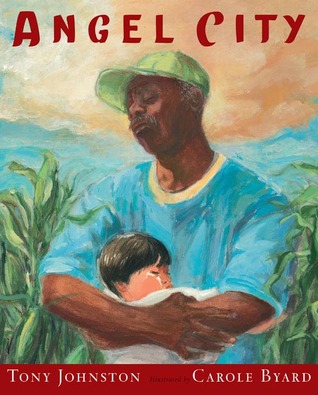
Excerpt: “Old man Joseph’s handy. Sees to most needs in his apartment building. Like plumbing. While the old man fits pipes and snakes out drains, Juan swashes toilets with a long-armed brush, for fun.”
A Chair for My Mother written and illustrated by Vera B. Williams

Excerpt: “That was last year, but we still have no sofa and no big chairs. When Mama comes home, her feet hurt. ‘There’s no good place for me to take a load off my feet,’ she says.
Fly Away Home by Eve Bunting; illustrated by Ronald Himler

Excerpt: “‘Will we ever have our own apartment again?’I ask Dad. I’d like it to be the way it was, before Mom died.
‘Maybe we will,’ he says. ‘If I can find more work. If we can save some money.’”
Sam and the Lucky Money by Karen Chinn; illustrated by Cornelius Van Wright & Ying-Hwan Hu

A Chinese American boy receives money from his grandparents for New Year’s and decides to give it to a homeless Chinese man, instead of spending it on himself.
Excerpt: “The stranger was rubbing his foot. Bare feet in winter! Sam thought. Where are his shoes? Sam stared at the man’s dirty clothes as he backed away.”
Something Beautiful by Sharon Dennis Wyeth; illustrated by Chris K. Soentpiet

An African-American girl living in the inner city is distressed by the lack of beauty in her neighborhood until she goes looking for “something beautiful.”
Excerpt: “I pick up the trash. I sweep up the glass. I scrub the door very hard. When Die disappears, I feel very powerful.
Someday I’ll plant flowers in my courtyard. I’ll invite all my friends to see.”
Tight Times by Barbara Shook Hazen; illustrated by Trina Schart Hyman
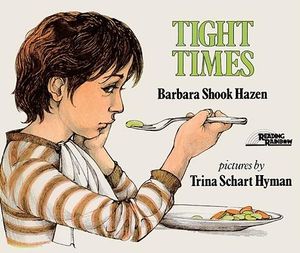
A young white boy living in a city apartment begs his parents for a dog, but they refuse because of “tight times.”
Excerpt: “Then Daddy fixed us both special drinks. He said he wasn’t mad at me. He said he was mad because he’d lost something.
I said look behind the radiator because that’s where I found my lost puzzle piece.
Daddy said it wasn’t that simple. What he’d lost was his job.”
Those Shoes by Maribeth Boelts; illustrated by Noah Z. Jones

An African American boy wants a pair of the trendy black high-tops that almost all his classmates are wearing.
Excerpt: “‘There’s no room for ‘want’ around here - just ‘need,’’ Grandma says. ‘And what you need are new boots for winter.”
____
Here's what I found missing from my research into picture book depictions of socioeconomic conditions: rural settings; any content about financial situations or social class in middle- or upper-income settings (economic conditions are only referenced when conditions are stressful).
Next post: Key Points for talking about class & race with children, thoughts about language and stereotypes, and a list of resources.
Please join in with any titles or ideas about this conversation.
Wednesday, December 12, 2012
Funded!
I'm Your Neighbor Books promotes the use of children’s literature featuring “new arrival” cultures and groups to engage the entire community in a discussion of commonalities and differences. The project features a recommended list of books and an evolving list of engagement projects for educators, librarians, and community organizations who seek to build bridges.
The inspiration for the project emerged from the recent publication of 7 titles about immigrants and refugees settling in Maine, including a nonfiction book for adults, an anthology of autobiographical stories by teenagers, three novels and two picture books (see below).
Next we'll be looking for additional funding for activities to enrich the community read, and for a school-based version of the project. All of the events will be documented so that they can serve as models for similar projects elsewhere in Maine and across the country.
Meanwhile, our website's booklist has an amazing collection of fiction, biography and memoir, from picture books through YA novels, about the contemporary immigrant and refugee experience, searchable by region, country, age and theme. Check it out!
And please share any titles you don't see listed.
The Maine “I’m Your Neighbor” collection, with the theme of each book discussion event, includes:
 I Remember Warm Rain: 15 Teenagers, 15 Coming to America Stories
by Various (Maine authors)
Description: Fifteen students, from countries such as Somalia, Iraq, Sudan, and Iran are represented in this anthology. In it, you meet Ali killing hyenas and Arunda speaking to his father by phone after ten years of believing he is dead; Kahiye, revealing his first experience of snow, and Stella doing something once forbidden to her, playing a game she loves: soccer. These rich stories were written as part of The Telling Room’s yearlong Story House Project, a multi-media initiative built on the collaborative efforts of local artists, writers, filmmakers, sound technicians, teachers and the 15 young storytellers who bravely told their tales of leaving home in hopes of finding a new one in America.
Publisher: Telling Room (Maine)
Setting: Greater Portland, ME
Featured Community: Multicultural
Ages: 10-Adult
Theme: Journeys
 New Mainers: Portraits of Our Immigrant Neighbors
by Pat Nyhan (Maine author), Jan Pieter Van Voorst Van Beest (Maine photographer),
Reza Jalali (Foreword-Maine author)
Description: Who are these new Mainers, and why have they come here? They are from war-torn countries such as Somalia, Sudan, Afghanistan, and Cambodia; from poor Latin American nations; and from economically vibrant places like Hong Kong, India, and Europe–in other words, from across the global spectrum. They came to Maine for a job or to reunite with their family or because they fell in love or to attend college here or to flee persecution in their homelands. Although the twenty-five immigrants who tell their stories had widely varying reasons for coming to Maine, many have made remarkable contributions to the state. The journeys of these immigrants have not been easy, but all of them are glad they wound up in this state and are proud of their new identities as Mainers.
Publisher: Tilbury House (Maine)
Setting: Greater Portland, ME, Maine
Featured Community: Multicultural American
Ages: 12-adult
Theme: Journeys
 A Path of Stars
by Anne Sibley O’Brien (Maine author/illustrator)
Description: A refugee from Cambodia, Dara’s beloved grandmother, Lok Yeay, is grief-stricken when she learns her brother–left behind in Cambodia–has died, and it is up to Dara to bring Lok Yeay back to a place of happiness.
Publisher: Charlesbridge / Maine Humanities Council (Maine)
Setting: Greater Portland, MEFeatured Community: Cambodian AmericanAges: 7-AdultTheme: Home
Description: Follows Viola as she survives brutality in war-torn Sudan, makes a perilous journey, lives as a refugee in Egypt, and finally reaches Portland, Maine, where her quest for freedom and security is hampered by memories of past horrors and the traditions her mother and other Sudanese adults hold dear. Includes historical facts and a map of Sudan.Publisher: Amazon Children’s PublishingSetting: South Sudan, Portland, MEFeatured Community: Sudanese AmericanAges: 14-AdultTheme: Home
 Moon Watchers: Shirin’s Ramadan Miracle
by Reza Jalali and Illustrated by Anne Sibley O’Brien (Maine author and illustrator)
Description: Moon Watchers offers an inside view of daily life in a modern Muslim family during Ramadan. Shirin and her older brother Ali have a history of not getting along, so when she discovers him sneaking food one afternoon during his Ramadan fast, she is tempted to tease him about his weakness. Instead of tattling, Shirin decides to mind her own business. She is determined to prove to her parents that she is ready to participate in this important rite of passage. Ultimately the little sister is surprised by a gift from her brother. Readers from all faiths will appreciate this universal story with its thought- provoking focus on family life.
Publisher: Tilbury House (Maine)Setting: Greater Portland, ME
Featured Community: Iranian American, Muslim American
Ages: 7-Adult
Theme: Traditions
A Path of Starsby Anne Sibley O’Brien (Maine author/illustrator)
Description: A refugee from Cambodia, Dara’s beloved grandmother, Lok Yeay, is grief-stricken when she learns her brother–left behind in Cambodia–has died, and it is up to Dara to bring Lok Yeay back to a place of happiness.
Publisher: Charlesbridge / Maine Humanities Council (Maine)
Setting: Greater Portland, MEFeatured Community: Cambodian AmericanAges: 7-AdultTheme: Home
 Moon Watchers: Shirin’s Ramadan Miracle
by Reza Jalali and Illustrated by Anne Sibley O’Brien (Maine author and illustrator)
Description: Moon Watchers offers an inside view of daily life in a modern Muslim family during Ramadan. Shirin and her older brother Ali have a history of not getting along, so when she discovers him sneaking food one afternoon during his Ramadan fast, she is tempted to tease him about his weakness. Instead of tattling, Shirin decides to mind her own business. She is determined to prove to her parents that she is ready to participate in this important rite of passage. Ultimately the little sister is surprised by a gift from her brother. Readers from all faiths will appreciate this universal story with its thought- provoking focus on family life.
Publisher: Tilbury House (Maine)Setting: Greater Portland, ME
Featured Community: Iranian American, Muslim American
Ages: 7-Adult
Theme: Traditions

Description: Enniston has become a “secondary migration” location for Somali refugees, who are seeking a better life after their country was destroyed by war–they can no longer go home. Tom hasn’t thought much about his Somali classmates until four of them join the soccer team, including Saeed. He comes out of nowhere on the field to make impossible shots, and suddenly the team is winning, dominating even; but when Saeed’s eligibility is questioned and Tom screws up in a big way, he’s left to grapple with a culture he doesn’t understand and take responsibility for his actions. Saeed and his family came out of nowhere and vanish just as quickly. And Tom may find himself going nowhere, too, if he doesn’t start trying to get somewhere.
Publisher: Knopf
Setting: Fictional Maine town based on Lewiston, Maine
Featured Community: Franco American, Catholic American, Somali American, Muslim American
Ages: 13-Adult
Theme: Traditions
Publisher: Knopf
Setting: Fictional Maine town based on Lewiston, Maine
Featured Community: Franco American, Catholic American, Somali American, Muslim American
Ages: 13-Adult
Theme: Traditions

Description: After ten years of living in America, a young girl is happy with the new world in which she lives and doesn’t understand why her parents yearn to return to their war-torn land of Kosova, yet when a sudden damaging act reestablishes old fears of hate, the Americanized student is forced to reexamine everything she thought she knew.
Publisher: Candlewick Press
Setting: Portland, ME, Lewiston, ME
Featured Community: Kosovar American
Ages: 10-Adult
Theme: Neighbors
Publisher: Candlewick Press
Setting: Portland, ME, Lewiston, ME
Featured Community: Kosovar American
Ages: 10-Adult
Theme: Neighbors
Monday, May 21, 2012
Children's Book Council: Join the Conversation
The Children's Book Council has formed a Diversity Committee, "dedicated to increasing the diversity of voices and experiences contributing to children's literature -- encouraging diversity of race, gender, geographical origin, sexual orientation, and class among both the creators of and the topics addressed by children's literature."

One of their goals is to "to strive for a more diverse range of employees working within the industry." On their new blog, begun in January, editors, writers and other children's book professionals from a range of backgrounds share stories of how they broke into the field.
On their bookshelf, they're featuring books that highlight cultural diversity.
 This week, the Diversity blog announces a new series, "It's Complicated," "a dialogue addressing a topic that has frequently arisen at the Diversity table -- the concept of responsibility and authenticity when writing about diverse characters and how authors, editors, and agents can choose/write stories that reflect the diverse nature of our society." They're inviting participation in the discussion - from writers and illustrators, editors and art directors, booksellers and reps, parents, teachers and librarians.
"It's an opportunity to become a partner in the effort to represent the diverse nature of our society in both the creators of and topics addressed by children's literature." Come have your say!
Saturday, April 28, 2012
Welcoming New Neighbors
Woke up this morning excited about a project I'm helping to develop: "I'm Your Neighbor: Reading Projects that Build Bridges Between New Arrivals and Longterm Communities."
We'll be presenting three titles as examples of the books and activities that "I'm Your Neighbor" will promote. All three are set in Maine.

The Good Braider by Terry Farish is a young adult novel featuring a South Sudanese girl making a new home in the U.S.

My own just-released A Path of Stars is a picture book told in the voice of a young Cambodian-American girl.
Please join us in building this project. Sign up to stay informed as the project develops: ImYourNeighborBooks. Share
More information in my post about A Path of Stars and the New Neighbors projects, on IRA's ENGAGE: Teacher to Teacher Blog
I’m Your Neighbor is a project which promotes the use of children’s literature featuring “new arrival” cultures and groups to engage the entire community in a discussion of commonalities and differences.
The project features a recommended list of books and an evolving list of engagement projects for educators, librarians, and community organizations who seek to build bridges.
The goal of the project is to both support communities as their cultural makeup evolves and to create opportunities for children’s literature featuring refugees, immigrants, and “new” marginalized groups.I'm headed to Chicago tomorrow to speak about the project at the International Reading Association Convention, with co-creators Kirsten Cappy (Curious City), book engagement consultant; and author Terry Farish. Our panel will address these questions:
How do we welcome new arrivals in a manner that truly makes room for them in the classroom, school or larger community, particularly when their cultural, language, religious and/or racial identities are unfamiliar to long-term community members?
How do we ensure that everyone in the community is engaged and appreciated so that resentment is diminished and learning can flow both ways?
We'll be presenting three titles as examples of the books and activities that "I'm Your Neighbor" will promote. All three are set in Maine.

The Good Braider by Terry Farish is a young adult novel featuring a South Sudanese girl making a new home in the U.S.


My own just-released A Path of Stars is a picture book told in the voice of a young Cambodian-American girl.
Please join us in building this project. Sign up to stay informed as the project develops: ImYourNeighborBooks. Share
- book titles
- questions and challenges
- suggestions for languages to include for buttons and t-shirts
- organizations we should know about
- possibilities for funding
More information in my post about A Path of Stars and the New Neighbors projects, on IRA's ENGAGE: Teacher to Teacher Blog
Tuesday, April 10, 2012
To be Cambodian American
Ten years ago, when I received a commission from the Maine Humanities Council under their New Mainers Book Project, my assignment was to create a picture book representing the Cambodian-American experience.
 I considered it an impossible task; that is, on my own, I could not produce an authentic Cambodian-American story. But I thought that if I listened long enough, perhaps a story might come through me. I read every book I could find about Cambodia, the war, the escape, and life in the U.S.; most titles were survivor accounts. The local community was wonderfully supportive, especially my friends, educators Peng and Veasna Kem, who shared their own stories as well as advising me throughout the process; and Pirun Sen, educator and founder of Watt Samaki Temple, who reviewed the final draft and wrote an afterword.
The book that resulted, A Path of Stars, was published in February (see announcement here). There are a few children's nonfiction titles featuring Cambodian Americans, including Who Belongs Here? An American Story, by Margy Burns Knight, which I illustrated; and there are several picture books set in Cambodia, including Fred Lipp's The Caged Birds of Phnom Penh). But to my knowledge, A Path of Stars is the only fiction picture book available about the Cambodian American experience. (Dara's Cambodian New Year by Sothea Chiemruom seems to be out of print, although copies can be found online.) [Please suggest any other titles in the comment section.]

The book's release has created wonderful chances to connect with Maine's Cambodian community, which numbers about 2000, including Portland's Cambodian Dance Troupe. In February my friend Tania Jo Hathaway, who manages the troupe and whose daughter Sophia is one of the dancers, invited me to share the book with them. Taught by Sokhoueun Sok, a classical dance performer trained in Phnom Penh, the troupe includes sixteen girls, ages 4 to 20. Some are 2nd-generation Cambodian Americans whose parents escaped the Khmer Rouge; others were born in Cambodia and adopted by American families.

This week I attended a delightful performance of the troupe, luminous in brilliant traditional clothing, at a New Year's Celebration (the Khmer new year is observed April 13-15). But classical dance wasn't the only item on the menu; there was also break-dancing duo, a band playing Khmer pop songs, and a hip hop group.

When I met with the girls in February, one of the ideas that struck me is that their identity is a relatively new one. Communities of Cambodian Americans, such as ours here in Maine, began taking root in the U.S. in the late 1970's. The oldest American-born Cambodians - in any significant numbers - are in their 30s. What it means to be Cambodian American is being defined now, in all its variety, by these young people, creating a brand-new, unique piece of the American mosaic.
I look forward to the day when books about the Cambodian-American experience will be written and illustrated by the people who are living that story.

Monday, March 26, 2012
Seeing What We Can't See

Just discovered a cute pack of 9 board books, the Baby Days Collection, published in 2007 by Little Scholastic, full of adorable baby faces of all colors.

But I was flabbergasted by the inner photos in Baby Bathes. Take a look:


Is it really possible that no editor ever noticed the progression of babies by skin color, and the subliminal message it conveys: a black baby = "time for a bath," a white baby = "clean baby?" (Stunning that the middle photos intensify the effect, with the baby's skin lighter in the 3rd spread.) Has no one at the publisher ever heard of incidents of very young children mistaking dark skin for dirty skin?
It's perfectly clear that no one meant to convey this message. In fact, it's obvious from the collection's design that the opposite was intended, that the set was meant to be warmly inclusive, to celebrate all kinds of babies.
But it's a clear example of the dominance of the white lens in the children's book industry. I find it hard to believe that an editor of color - or a white editor who was well-versed in the significance of racial images - would not have noticed this. There's intention, and there's impact.
We can't see what we're taught to not see.
Sunday, March 11, 2012
Encounter
Yesterday I spoke on a panel for an SCBWI New England event on using marketing consultants at the Eric Carle Museum in Amherst, Massachusetts. Lovely to make the trip with Kirsten Cappy of Curious City, and writer-illustrator Cathryn Falwell.
During lunch we got to spend a few minutes viewing the exhibit of Kadir Nelson paintings published in the book, We Are the Ship: The Story of Negro League Baseball. The illustrations are stunning, and the exhibit far more so, because the actual oil paintings are huge.

Entering the gallery, you encounter the life-size figure of catcher and slugger Josh Gibson, who hit 75 home runs in 1931. The painting (also the book's cover illustration) is hung so that the ball player and museum visitor meet eye to eye. Gibson has a powerful, almost mythical presence, rendered with extraordinary lifelike detail, from gleaming flesh to fraying fabric around the collar. Brushstrokes in the surrounding sky suggest motion, as if the air around the still figure is vibrating.
The paintings are striking in their strength, depth of color, contrast in light and shadow, and stylistic distortions that make them more expressive and memorable than if they were photo-realistic. As a group, they are a vivid and indelible account, bringing the players of the Negro League alive. An added delight is the display of rough thumbnail sketches.
This summer, the paintings will be on display at the Western Pennsylvania Sports Museum in Pittsburgh. Three, including the portrait of Josh Gibson, have been purchased by the Muskegon Museum of Art in Michigan.
The artist is quoted in an exhibition brochure:
"What I found most striking was the story of the Negro League; its overwhelming success despite the daunting odds against it. The spirit of independence, having made something out of nothing at all. Armed with only intellectual and athletic talents, and the sheer will to play the game that they loved so dearly, this group of men assumed control of their destiny. After being pushed out of the game by an overwhelming majority, African-Americans, rather than giving up, formed leagues of their own, successful leagues that lasted almost thirty years.
"Overall, I hope that I have done justice to these somewhat forgotten men and given them the tribute that they deserve. I don't wish to deify them but rather honor them, portray them as the heroes they were and further solidify their place in history."
Friday, October 14, 2011
How to Talk About Race: A List of Books
 Next week I'll be leading an educators workshop and co-leading a community event on talking about race with children. A book sale will accompany the presentations, with a small selection of children's books that are natural catalysts for starting a conversation on race. (Update: Here's a short TV interview about the programs.)
My co-presenter, Bates College psychology professor Krista Aronson, and I have identified three core categories of books that are useful in addressing race, in order of their developmental application:
1. Celebration of differences (CD)
Simply naming and appreciating difference is an essential foundation for conversations about race. Children are already making these observations; talking about them gives children permission and language to voice them. The goal of these interactions is not so much to teach as to create an open forum for children to say whatever they see. Supportive adults then have the opportunity to assist children in developing positive racial associations of both themselves and people different from them.
2. Cross-group (CG)
In psychological research studies, books portraying positive interactions across racial difference have been shown to reduce prejudice (see the work of Rupert Brown). These books show cross-racial friendships which can strengthen children's developing appreciation of and sense of connection to people who look different from them.
3. Racism
Stories of prejudice, mistreatment and discrimination are an essential part of any reality-based education about race, but not as the only or the first story. Too often, when well-intentioned adults want to introduce concepts of race to children, they start with books about the civil rights movement. This is problematic in several ways: Children learn to associate discussions of race with discomfort, conflict, and possibly guilt, and African-Americans may be seen only in the light of a difficult history. In other words, children may absorb the idea of race as a problem and people of color as victims.
However, when presented by a relaxed and practiced facilitator in the context of a broader, ongoing conversation, these stories can be powerful catalysts for provocative conversations, memorable learning, and the development of empathy. Again, the focus of discussion should be on eliciting children's thoughts and feelings and on developing their critical thinking skills.
 Here are some examples of books in each category (grade levels are suggestions only).
preschool - Gr. 2
All the Colors of the Earth by Sheila Hamanaka - CD (Multiracial)
Amazing Faces compiled by Lee Bennett Hopkins - CD, CG (Multiracial)
Bein’ With You This Way by W. Nikola-Lisa - CD (Multiracial)
Come On, Rain by Karen Hesse - CG (Black/Asian/White)
Jamaica & Brianna by Juanita Havill - CG (Black/Asian)
Shades of People by Shelley Rotner - CD (Multiracial)
Gr. 1 - 4
Baseball Saved Us - R (Japanese-American)
The Bracelet by Yoshiko Uchida - R, CG (Japanese-American)
Chicken Sunday by Patricia Polacco - CG (White/Black/Jewish) Jacqueline Woodson
Freedom Summer by Deborah Wiles - R, CG (White/Black)
The Other Side by Jacqueline Woodson - R, CG (Black/White)
Ruth and the Green Book by Calvin Alexander Ramsey - R (Black)
Gr. 3 - 7
The Basket Counts Matt Christopher - R, CG (Black/White)
Feathers by Jacqueline Woodson - CG, R (Black/White)
The Friendship by Mildred Taylor - R (Black/White)
The Other Half of My Heart by Sundee Frazier - CG, R (Black/White/Biracial twins)
Witness by Karen Hesse - R, CG (White/Black/Jewish)
Gr. 7 - 12
The Absolutely True Story of a Part Time Indian by Sherman Alexie - R, CG (Native-American)
American-Born Chinese by Gene Luen Yang - R, CG (Chinese-American)
Face Relations: Eleven Stories About Seeing Beyond Color edited by Marilyn Singer - R, CG (Multiracial)
The Girl Who Fell From the Sky by Heidi Durrow - R, CG (Biracial/Black/White)
I Hadn’t Meant to Tell You This by Jacqueline Woodson - CG, R (Black/White)
Tuesday, July 12, 2011
The Skin I'm In: A First Look at Racism
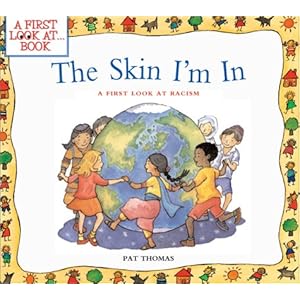
A reader (thanks, Reena) brought this book, The Skin I'm In: A First Look at Racism by Pat Thomas, to my attention. In an Amazon search, it's the only picture book I found that directly mentions racism as the topic of the book.
Age: 4-8
First lines:
page 6
"Imagine a world where only people with blue eyes could go to school. Or a world where only people with brown eyes could get a job."
(Double-page illustration of a classroom full of happy, active children - oddly, all with reddish hair, and all white-skinned except three with brown skin - and a brown-skinned, black-haired teacher. Outside, many sad children - with a variety of skin and hair color and racial features, some dressed in ethnic clothing - look through the window. Eyes are drawn with black dots, so no eye color is visible.)
page 7
"If we lived in a world like this many people would be treated unfairly. They would miss out on the chance to learn and work and feel good about themselves."
page 8
"The way you look is decided by your family background. Sometimes this is called your culture, or race. The most common way race is judged is by the color of your skin." (Illustration of dark-skinned family with curly black hair.)
page 9
"Your race tells the history of your family. It is where your ancestors come from and the religion and traditions your family has followed for many years." (Illustration of Jewish family with yarmulkes and menorah.)
Central idea:
"Some believe that people from their race are worth more and should be treated better than people from other races. A person who thinks and acts this way is called a racist. Racists want to stop people of other races from living, working and learning together. Anybody of any skin color can be a racist."
My take:
This is a well-meaning book in the First Look series, which includes titles on teasing, honesty, death, disability, and other issues, all written by "psychotherapist and counselor" Pat Thomas. The book brings to minds a statement I once heard Native American author Joseph Bruchac make about the book Brother Eagle, Sister Sky: "Its heart is good but its mind is lost." I've quoted more first lines than usual because I wanted to convey the sense of the text, which I find choppy and sometimes incoherent, and the content, some of which is confusing and at times downright misleading. The biggest problems I see are:
1. There is no clear definition of race. The implication that race includes culture, religion and traditions only complicates a topic that is already confusing to children (and adults).
2. The text defines racism as synonymous with individual acts of racial prejudice. There is no attempt to address in-groups and out-groups, and the reality of racism as a pervasive and systemic societal problem, not just people being mean. Granted, tackling this topic for young children in a developmentally-appropriate manner is very challenging, but many kindergarteners have heard the story of Rosa Parks and been exposed to the idea of laws based on race. If only individual attitudes and behaviors are mentioned, it should be called racial prejudice, not racism.
3. The illustrations, though pleasant and appealing, are sometimes more distracting and confusing than illuminating. For instance, the text, "Have you ever been afraid of somebody that looked different from you?" is accompanied by two children (one brown, one white) looking nervously at an adult clown. In addition, as a friend pointed out (thanks, Kim), all the children's features are drawn identically, different only in skin color, hair style and color, and clothing, which seems an exceptionally odd choice for a book about race.
---
The book does have some useful language and ideas: that a trusted adult should always be told when a child encounters racist behavior; that "sometimes racist behavior ... can be hidden in the way people treat each other or talk about each other;" that "Most people want the world to be a place where each of us gets the same opportunities to make friends and to learn and grow." A knowledgeable adult could use portions of the book as the springboard for a discussion with young listeners.
But clearly, we need more books that address the topic of racism for young children.
Wednesday, April 27, 2011
Books on Skin Color & Race
In this post I'm focusing on young picture books which directly and generally address skin color and racial features which could be used to start a discussion about race with children ages 3-8. I've listed the titles from youngest to oldest reading level.
Shades of People by Shelley Rotner and Sheila M. Kelly (2009)
 Age: 3-7
First lines: "Have you noticed that people come in many different shades? Not colors, exactly, but shades. There's creamy, ivory, sandy and peach, coffee, cocoa, copper and tan."
A simple concept book with minimal text, naming many shades of skin color, illustrated with dozens of photographs of a wide range of irresistible children's faces.
Central idea: "Our skin is just our covering, like wrapping paper. And, you can't tell what someone is like from the color of their skin."
My take: This is the best overall concept book on skin color I've found. The text is direct and plain-spoken, with no value judgments, no need to sell the concept. (I have a few quibbles with photo choices, text placement, and which colors come first, but these are minor.)
All the Colors of the Earth by Sheila Hamanaka (1994)
 Age: 4-7
First lines: "Children come in all the colors of the earth / The roaring browns of bears and soaring eagles, / The whispering golds of late summer grasses, / And crackling russets of fallen leaves, / The tinkling pinks of tiny seashells by the rumbling sea."
A joyous and poetic celebration, "inspired by her own two children's multi-ethnic heritage," of the range of colors in skin and hair, depicted in oil paintings of realistic children in fanciful natural settings. Several spreads show biracial families.
Central idea: "Children come in all the colors of the earth and sky and sea."
My take: This book is an old favorite, exuberant in its appreciation of the beauty of difference, and I love Sheila Hamanaka's tender portraits of children. It may seem too flowery and sentimental for some tastes.
The Colors of Us by Karen Katz (1999)
 Age: 4-8
First lines: "My name is Lena, and I am seven. I am the color of cinnamon. My mom says she could eat me up."
When Lena says that "brown is brown," her artist mother ("the color of French toast") takes her on a walk to find all the colors of brown in their neighborhood. Bold flat color and bright patterns.
Central idea: "Look at everyone's legs, Mom - all the different shades."
My take: The nonfiction-masquerading-as-fiction format is a pet peeve of mine, and the adult neighbors have stereotypical ethnic roles (Mr. Pellegrino makes pizza, Mr. Kashmir "sells many different spices" and has a turban and a curling mustache, and the only dark-skinned black adult, Candy, is a babysitter who "looks like a princess"). The story has a fun ending, with Lena making charming portraits of everyone in "all the colors of us."
The Skin You Live In by Michael Tyler, illustrated by David Lee Csicsko (2005)
 Age: 4-8
First Lines: "Hey, look at your skin ... The wonderful skin you live in! The skin you're all day in; the skin that you play in; the skin that you snuggle up, cuddle up, lay in."
A rollicking rhyming book about skin, including its variety of colors, produced by the Chicago Children's Museum.
Central Idea: "... the skin you live in, so beautifully holds the 'You' who's within... We all make a beauty, so wonderfully true. We are special and different and just the same, too!"
My take: The text is bouncy, playful and entertaining, with amusing and surprising rhymes ("It's face the rain bold skin and snow-angel cold skin"), good for keeping the attention of a story hour. The references to colors come only in the middle of the book, in the context of what we all have in common.
The art is graphically pleasing but sometimes puzzling in content: almost all children have football-shaped heads with ear knobs on the ends (see cover). The only exceptions are a few faces, particularly the recurring Asian girl (the only Asian character), whose head is rounded with only one ear. Given the topic, it seems odd to set up such a strong pattern and then break it in this random way, bringing to mind the Sesame Street song, "Which of these things is not like the other?"
---
Despite my caveats, I'd use any of these books to start a conversation about skin color and race (and with older children, topics like stereotypes can be part of the discussion).
Got any other recommendations for books that directly address skin color and racial features for children ages 3-8?
(At this point I'm not including books such as Black is Brown is Tan, about a particular biracial family, though of course it could be used to spark a discussion on race; I'm saving it and similar titles for a post about books featuring biracial and multiracial families.)
Shades of People by Shelley Rotner and Sheila M. Kelly (2009)
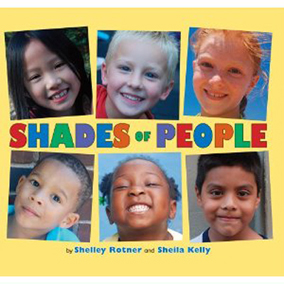 Age: 3-7
First lines: "Have you noticed that people come in many different shades? Not colors, exactly, but shades. There's creamy, ivory, sandy and peach, coffee, cocoa, copper and tan."
A simple concept book with minimal text, naming many shades of skin color, illustrated with dozens of photographs of a wide range of irresistible children's faces.
Central idea: "Our skin is just our covering, like wrapping paper. And, you can't tell what someone is like from the color of their skin."
My take: This is the best overall concept book on skin color I've found. The text is direct and plain-spoken, with no value judgments, no need to sell the concept. (I have a few quibbles with photo choices, text placement, and which colors come first, but these are minor.)
All the Colors of the Earth by Sheila Hamanaka (1994)
 Age: 4-7
First lines: "Children come in all the colors of the earth / The roaring browns of bears and soaring eagles, / The whispering golds of late summer grasses, / And crackling russets of fallen leaves, / The tinkling pinks of tiny seashells by the rumbling sea."
A joyous and poetic celebration, "inspired by her own two children's multi-ethnic heritage," of the range of colors in skin and hair, depicted in oil paintings of realistic children in fanciful natural settings. Several spreads show biracial families.
Central idea: "Children come in all the colors of the earth and sky and sea."
My take: This book is an old favorite, exuberant in its appreciation of the beauty of difference, and I love Sheila Hamanaka's tender portraits of children. It may seem too flowery and sentimental for some tastes.
The Colors of Us by Karen Katz (1999)
 Age: 4-8
First lines: "My name is Lena, and I am seven. I am the color of cinnamon. My mom says she could eat me up."
When Lena says that "brown is brown," her artist mother ("the color of French toast") takes her on a walk to find all the colors of brown in their neighborhood. Bold flat color and bright patterns.
Central idea: "Look at everyone's legs, Mom - all the different shades."
My take: The nonfiction-masquerading-as-fiction format is a pet peeve of mine, and the adult neighbors have stereotypical ethnic roles (Mr. Pellegrino makes pizza, Mr. Kashmir "sells many different spices" and has a turban and a curling mustache, and the only dark-skinned black adult, Candy, is a babysitter who "looks like a princess"). The story has a fun ending, with Lena making charming portraits of everyone in "all the colors of us."
The Skin You Live In by Michael Tyler, illustrated by David Lee Csicsko (2005)
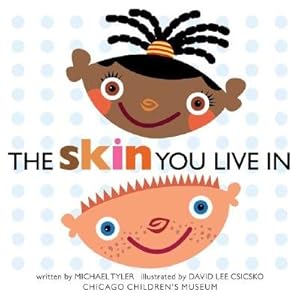 Age: 4-8
First Lines: "Hey, look at your skin ... The wonderful skin you live in! The skin you're all day in; the skin that you play in; the skin that you snuggle up, cuddle up, lay in."
A rollicking rhyming book about skin, including its variety of colors, produced by the Chicago Children's Museum.
Central Idea: "... the skin you live in, so beautifully holds the 'You' who's within... We all make a beauty, so wonderfully true. We are special and different and just the same, too!"
My take: The text is bouncy, playful and entertaining, with amusing and surprising rhymes ("It's face the rain bold skin and snow-angel cold skin"), good for keeping the attention of a story hour. The references to colors come only in the middle of the book, in the context of what we all have in common.
The art is graphically pleasing but sometimes puzzling in content: almost all children have football-shaped heads with ear knobs on the ends (see cover). The only exceptions are a few faces, particularly the recurring Asian girl (the only Asian character), whose head is rounded with only one ear. Given the topic, it seems odd to set up such a strong pattern and then break it in this random way, bringing to mind the Sesame Street song, "Which of these things is not like the other?"
---
Despite my caveats, I'd use any of these books to start a conversation about skin color and race (and with older children, topics like stereotypes can be part of the discussion).
Got any other recommendations for books that directly address skin color and racial features for children ages 3-8?
(At this point I'm not including books such as Black is Brown is Tan, about a particular biracial family, though of course it could be used to spark a discussion on race; I'm saving it and similar titles for a post about books featuring biracial and multiracial families.)
Race Talk with Young Kids: How to Start
 When our Korean-born daughter was four or five, one of her favorite adults was Hyo-Jung, a young Korean-American friend.
At some point during each visit with our daughter, Hyo-Jung would lift a strand of her glossy, straight black hair, then a similar strand of Yunhee's, and sing, "Same hair!" The game never failed to delight Yunhee and I'm sure helped forge a deep bond with this lovely woman who looked like her, as none of her immediate family members did.
Hyo-Jung was simply pointing out the obvious, in a relaxed, playful, affirming tone. For people who've been dealing with race every day of their lives, as many people of color do in the U.S., this might not be a difficult feat; it's an everyday topic.
But research shows that, by some counts, "75% of white families never or almost never talk about race with their children." Obviously, if statistics like that cover your experience, breaching the topic may not come out relaxed, playful, and affirming the first few times. But it's a good standard to reach for.
Here are some first steps for talking about race with very young children:
Start with the assumption that our children DO notice race. Just because they don't appear to based on what they say doesn't mean they're not categorizing. Many studies have documented that children - and even infants as young as four months - detect differences in skin color.
Where in the world did we get the idea that they don't see it? Children are natural sorters. They see, and we teach them, the "green car, pink pig, yellow flower, red ball, brown shirt ..." but all of a sudden when the color is on skin, it's invisible?
Of course, one of the reasons that children don't voice their observations is that the adults around them have given them implicit but clear messages that it's not to be talked about.
Include colors of skin and shapes of features in sorting games, as naturally as referring to the grass, the cat or the ball. Color identification, comparing and contrasting, alike and different ("Same hair!"). That's all that very young children are seeing. Those categorizations don't yet come with the charged complexity or value judgments that older people bring to the topic.
 Tailor the conversation to children's ages and developmental stages. As with so many other topics, adjust the amount and type of information as children mature, and as needed in response to their questions and comments.
And, picture books are a great way to introduce the topic.
Next up, six titles that can start the conversation.
Further reading:
Here's a terrific short article, "5 Tips for Talking About Racism with Kids," including a Q&A with Dr. Beverly Tatum, president of Spelman College and author of Why Are All the Black Kids Sitting Together in the Cafeteria? And Other Conversations about Race, one of the nation's foremost authorities on racial identity development and race conversations. (My only quibble is that to accurately reflect the content of the piece, the title should say "Race," not "Racism." Talking about racism, though it can overlap, is another topic for another post.)
Subscribe to:
Posts (Atom)