Monday, April 29, 2013

Class Talk II

For my White Privilege Conference workshop (see previous post) on using children's books to talk about class, I prepared this handout, an adaptation of the one I've posted previously on talking about race:


Key Points for Talking About Class & Race with Children

1. Be welcoming, open & inquiring
Children's comments, questions and experiences (including the things we wish they wouldn’t say) are opportunities to talk, listen and learn. The goal is to find out what children are thinking and to give them permission and language to voice their ideas and impressions.

2. Be concerns-based
As with all conversations with children, developmental and emotional readiness should determine what we do and don't say - what's appropriate and what's effective. Our responses should be tailored to the particular child/ren and particular situation.

3. Be empowering
 Conversations about economic and racial injustice should always include ideas about how children can respond and that adults are available to help.
The most essential teaching for children to absorb is a sense of hope and possibility. The content can be hard and heavy, but we can address it lightly. Provoking guilt or fear does not empower young people to tackle the challenges of prejudice and injustice.

4. Be inclusive
Class and race should be framed as about “all of us,” not through the majority group lens of “Us/Them.” Though our experiences may be very different based on the groups we belong to, everyone has a class and racial identity and everyone’s life is affected by class and race, whether we are aware of it or not.

5. Address systems, social roles and power
Classism and racism are not the same as "being mean." Prejudice based on economic status, and on skin color and racial features, is a universal human tendency, but classism and racism are not just personal, they are collective and institutional as well. In order to process their own experience and to develop effective skills, young people need age-appropriate information about how U.S. society advantages upper income and white people, and disadvantages lower income people and people of color.

If the adults caring for them do not offer concrete, direct, and bold language, guidance and models for counteracting the dominant culture's messages about class and race, children's attitudes and behaviors will be formed by these influences, and they will act out the class and racial roles that society has assigned them.

6. Offer ourselves as role models.
In order to lead these conversations, we adults must be willing to challenge and shift our own attitudes and behaviors, and offer our process of examining class and race in our own lives as a model that children can look to and learn from.


 Resources:

Sunday, April 28, 2013

Class Talk I

For the White Privilege Conference earlier this month, I was asked to redesign my workshop, "Using Children's Books to Talk about Race," to focus on talking about class, in line with the conference's focus, "The Color of Money." Here's the description of the new workshop I presented:
Talk About Class: Using Children's Books to Spark Conversations

Socioeconomic class in the U.S. can be even harder to talk about than race, and the silences leave children absorbing unchallenged messages from the dominant culture. Depictions of economic realities in children's books offer the opportunity to engage children in discussion, to find out what they are thinking and to give them permission and language to voice their ideas and impressions.
I developed this list of selected, recommended titles (In a later post, I'll suggest a few titles for older readers):


"Talk About Class"
A Selected, Annotated List of Recommended Picture Books
 
compiled by Anne Sibley O’Brien
"Children’s literature, an artifact of cultural, social and economic values, provides a window into the ways in which children are socialized to think about social class. And, yet, there is often a silenced dialogue around matters of social class and poverty in society and schools." 
Rebecca Rogers,
"Using Children’s Literature to Explore Social Class and Poverty in Times of Economic Crisis"

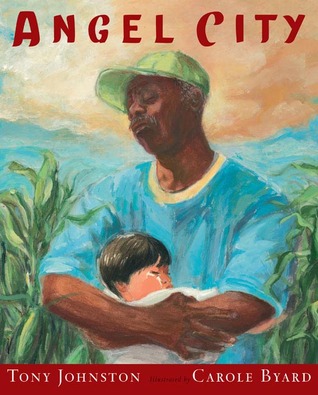
Angel City by Tony Johnston; illustrated by Carole Byard

An older African-American man finds an abandoned Mexican baby in a dumpster in a Los Angeles barrio and determines to raise the child as his own.

Excerpt: “Old man Joseph’s handy. Sees to most needs in his apartment building. Like plumbing. While the old man fits pipes and snakes out drains, Juan swashes toilets with a long-armed brush, for fun.” 


A Chair for My Mother written and illustrated by Vera B. Williams

A young girl, her grandmother, and her mother, who works as a waitress, save money for a comfortable chair in their new apartment after a fire destroys their home.

Excerpt: “That was last year, but we still have no sofa and no big chairs. When Mama comes home, her feet hurt. ‘There’s no good place for me to take a load off my feet,’ she says.


Fly Away Home by Eve Bunting; illustrated by Ronald Himler

A homeless white father and son live in an airport. (Also features their friends, the Medinas, a homeless Latino family who care for the boy while the father works.)

Excerpt: “‘Will we ever have our own apartment again?’I ask Dad. I’d like it to be the way it was, before Mom died.
‘Maybe we will,’ he says. ‘If I can find more work. If we can save some money.’”


Sam and the Lucky Money by Karen Chinn; illustrated by Cornelius Van Wright & Ying-Hwan Hu


A Chinese American boy receives money from his grandparents for New Year’s and decides to give it to a homeless Chinese man, instead of spending it on himself.

Excerpt: “The stranger was rubbing his foot. Bare feet in winter! Sam thought. Where are his shoes? Sam stared at the man’s dirty clothes as he backed away.” 


Something Beautiful by Sharon Dennis Wyeth; illustrated by Chris K. Soentpiet


An African-American girl living in the inner city is distressed by the lack of beauty in her neighborhood until she goes looking for “something beautiful.”

Excerpt: “I pick up the trash. I sweep up the glass. I scrub the door very hard. When Die disappears, I feel very powerful.
Someday I’ll plant flowers in my courtyard. I’ll invite all my friends to see.”


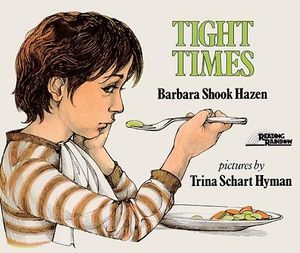
Tight Times by Barbara Shook Hazen; illustrated by Trina Schart Hyman


A young white boy living in a city apartment begs his parents for a dog, but they refuse because of “tight times.”

Excerpt: “Then Daddy fixed us both special drinks. He said he wasn’t mad at me. He said he was mad because he’d lost something.
I said look behind the radiator because that’s where I found my lost puzzle piece.
Daddy said it wasn’t that simple. What he’d lost was his job.”


Those Shoes by Maribeth Boelts; illustrated by Noah Z. Jones


An African American boy wants a pair of the trendy black high-tops that almost all his classmates are wearing.

Excerpt: “‘There’s no room for ‘want’ around here - just ‘need,’’ Grandma says. ‘And what you need are new boots for winter.”
____


Here are a few of the themes from these books: resourcefulness, creativity, family connection, community support and interdependence, cross-racial friendships, dreams, financial challenge and stress, hard work, empathy, generosity, hope

Here's what I found missing from my research into picture book depictions of socioeconomic conditions: rural settings; any content about financial situations or social class in middle- or upper-income settings (economic conditions are only referenced when conditions are stressful).

Next post: Key Points for talking about class & race with children, thoughts about language and stereotypes, and a list of resources.

Please join in  with any titles or ideas about this conversation.

Monday, April 22, 2013

The White Privilege Conference


In the second week of April, I attended the 14th annual White Privilege Conference (WPC), held this year in Seattle. More than 2000 people of all races - students, educators, nonprofit staff, social workers, counselors, parents and activists - attended this year's gathering, "The Color of Money," focusing on the intersections of class and race.


WPC, founded by African American educator Eddie Moore, "aims to create a learning community in which participants engage in a challenging educational experience as respectful community members." At the opening ceremony, Moore reminded the attendees that the work was grounded in relationships. "Some things," he told us, "are non-negotiable: handshakes and hugs." A Community Agreement emphasizes the philosophy of “understanding, respecting and connecting.”

I presented a workshop (twice) on using children's books to spark conversations about class and race (next post). My experience was abundantly challenging and educational, and the community was indeed full of respect and opportunities to connect, around commonalities and across all kinds of differences.

I was reminded once again of how useful it is to continue to put myself in situations that stir up awareness of my own race and class privilege, let me see the patterns that are so often invisible, and to move through discomfort to new learnings and more freedom. For anyone on this journey, I highly recommend the experience.


WPC 15 is scheduled for spring 2014 Madison, Wisconsin. Maybe I'll see you there.

Thursday, April 4, 2013

Parenting Across Race

A new essay I wrote,"Raising Yunhee," on transracial adoption and parenting across race, has just been published at Korean American Story.


"Adopting Yunhee was one journey; raising her was another. My own passion for Korea, which became my second homeland and the source of my second culture and second language, made me determined to give Yunhee a sense of her birth legacy. But how does a white American, even one who grew up in Korea, raise a Korean American - on an island in Maine?"
Yunhee was the model for Brianna in Brianna, Jamaica and the Dance of Spring

 The essay examines how we attempted to give our daughter not just a sense of where she came from, but also encouragement to voice her experience of growing up as an American of color, and the challenge that posed for us as white parents:
"Talking about race gave Yunhee permission and language to unpack her own observations and experiences, and a structure for understanding the nuances of racial identity in America. At various ages and stages, it helped her find her voice to express her grief, her rage, her confusion (at age six, "Why couldn't somebody in Korea take care of me?")... It was essential for me not just to convey that all her thoughts and feelings were welcome, but also to become aware enough of the filter of my own white and non-adopted privilege that I could respect Yunhee's authority in naming realities as she perceived them. I had to work to not inadvertently discount her observations and difficulties just because I wished they weren't true."
Korean American Story is building a fine and useful archive of narratives across the spectrum of Korean American identity, a significant contribution to exploring what it means to be American.
Go take a look.