Monday, March 26, 2012

Seeing What We Can't See

Just discovered a cute pack of 9 board books, the Baby Days Collection, published in 2007 by Little Scholastic, full of adorable baby faces of all colors.

But I was flabbergasted by the inner photos in Baby Bathes. Take a look:


Is it really possible that no editor ever noticed the progression of babies by skin color, and the subliminal message it conveys: a black baby = "time for a bath," a white baby = "clean baby?" (Stunning that the middle photos intensify the effect, with the baby's skin lighter in the 3rd spread.) Has no one at the publisher ever heard of incidents of very young children mistaking dark skin for dirty skin?

It's perfectly clear that no one meant to convey this message. In fact, it's obvious from the collection's design that the opposite was intended, that the set was meant to be warmly inclusive, to celebrate all kinds of babies. 

But it's a clear example of the dominance of the white lens in the children's book industry. I find it hard to believe that an editor of color - or a white editor who was well-versed in the significance of racial images - would not have noticed this. There's intention, and there's impact.

We can't see what we're taught to not see.


Wednesday, March 21, 2012

International Day for the Elimination of Racial Discrimination

"Racism continues to cause suffering for millions of people around the world.... I look to all people to join the United Nations in our drive to eliminate racism. We must, individually and collectively, stamp out racism, stigma and prejudice." U.N. General Secretary Ban Ki-moon
Today is the United Nation's declared International Day for the Elimination of Racial Discrimination"The theme for this year's event is 'Racism and Conflict,' highlighting the fact that racism and discrimination often are at the root of deadly conflict."


It might be hard to imagine how to respond to a war of genocide based on race in a country far away, or even to an attack on a teenage boy walking home at night in a Florida neighborhood. But there is significant work creative people can do right here, right now, within our own psyches.


1. Explore our own stories.
The concept that a difference of skin color or eye shape renders someone less than and therefore threatening lurks in all of our unconscious minds.  One thing we can do, anywhere, any day, is to explore the bias we've absorbed. Bring it out into the cleansing light and investigate it, without judgment, like detectives gathering clues. 


Ask yourself questions such as:

  • What ideas about race did you get exposed to without your permission?
  • What racial realities did you witness as a child, at home, in your community, in the world at large?
  • How did you observe adults behaving in response to race?
  • What messages were transmitted, often by implication, about your role in it all, based on your racial group(s)?
  • How might any of this have lodged in your mind, out of reach of your conscious thoughts, but affecting your attitudes and behaviors? (This is especially true of white socialization, which is often rooted in the invisibility of and silence about race.)

2. Create a new vision.
Today also happens to be World Poetry Day (thanks for the tip, Kirsten!). There's a connection that can be made between the two.


As creators and users of children's books, as parents, as educators, as people who care about all of our children, we can help "stamp out racism" by imagining a different reality, so vivid and full of light that the idea of judging others by race withers in its shadow. Not a pale, pastel "color-shouldn't-matter" tolerance. But a fierce, primary-colored, "that's-my-family-you're-talking-about" pride that demands recognition of the connection among and essentiality of all of us. That can leave no one behind. 


On the international days for the Elimination of Racism and for Poetry, what's your vision of how we might all be, together?


***
(My own vision is temporarily limited to words in the aftermath of the death of my computer. Images from my illustrations will return, as soon as I'm back up and running, digitally.)

Monday, March 19, 2012

Exploring a Bicultural Experience

One of my favorite blogs, Korean American Story, has just published a piece I was invited to write for them, "Of Longing and Belonging."

This relatively new blog has already built a thoughtful and insightful collection of essays and fiction on what it means to be Korean and American, including immigrant, U.S.-born, and adoptee perspectives.

Sunday, March 11, 2012

Encounter

Yesterday I spoke on a panel for an SCBWI New England event on using marketing consultants at the Eric Carle Museum in Amherst, Massachusetts. Lovely to make the trip with Kirsten Cappy of Curious City, and writer-illustrator Cathryn Falwell.

During lunch we got to spend a few minutes viewing the exhibit of Kadir Nelson paintings published in the book, We Are the Ship: The Story of Negro League Baseball. The illustrations are stunning, and the exhibit far more so, because the actual oil paintings are huge.


Entering the gallery, you encounter the life-size figure of catcher and slugger Josh Gibson, who hit 75 home runs in 1931. The painting (also the book's cover illustration) is hung so that the ball player and museum visitor meet eye to eye. Gibson has a powerful, almost mythical presence, rendered with extraordinary lifelike detail, from gleaming flesh to fraying fabric around the collar. Brushstrokes in the surrounding sky suggest motion, as if the air around the still figure is vibrating.

The paintings are striking in their strength, depth of color, contrast in light and shadow, and stylistic distortions that make them more expressive and memorable than if they were photo-realistic. As a group, they are a vivid and indelible account, bringing the players of the Negro League alive. An added delight is the display of rough thumbnail sketches.

This summer, the paintings will be on display at the Western Pennsylvania Sports Museum in Pittsburgh. Three, including the portrait of Josh Gibson, have been purchased by the Muskegon Museum of Art in Michigan.

The artist is quoted in an exhibition brochure:

"What I found most striking was the story of the Negro League; its overwhelming success despite the daunting odds against it. The spirit of independence, having made something out of nothing at all. Armed with only intellectual and athletic talents, and the sheer will to play the game that they loved so dearly, this group of men assumed control of their destiny. After being pushed out of the game by an overwhelming majority, African-Americans, rather than giving up, formed leagues of their own, successful leagues that lasted almost thirty years.

"Overall, I hope that I have done justice to these somewhat forgotten men and given them the tribute that they deserve. I don't wish to deify them but rather honor them, portray them as the heroes they were and further solidify their place in history."

Friday, March 2, 2012

Blogger Affinity

An entire month ago (I was just back from Italy, still in a travel fog ...), Michelle of "Polliwog on Safari" kindly gave me a Liebster Award.


Because I recently posted in relation to a Versatile Blogger Award (and because I don't read enough blogs to make another recommended list!), I'll refer back to my original responses to the questions.

And here's a belated appreciation to Michelle, a teacher and fellow writer who shares my passion for exploring race and whiteness - thanks!

Fierce Girls

Three recent graphic novels feature feisty girl protagonists whose ethnic identity places them on the margins of mainstream society, yet whose life questions, personal challenges and eventual triumphs will be recognizable to young people of any background.

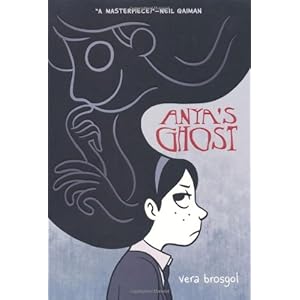
Anya, the protagonist of Anya's Ghost by Vera Brosgol, is a teenager of Russian descent trying to fit in at her American high school and catch the attention of her heartthrob, when she falls into a well in a park and meets the ghost of a long-dead girl. This beautifully-drawn and suspenseful novel, told completely in dialogue and images, adds a thriller mystery plot and a be-careful-what-you-wish-for theme to typical teen concerns of identity, popularity and finding one's place. "I don't know if I'll ever be the same after that fall," Anya tells the school principal at the story's close.


Hereville: How Mirka Got Her Sword by Barry Deutsch (with the irresistible tag line: "Yet Another Troll-Fighting 11-Year-Old Orthodox Jewish Girl")  is set in an Orthodox community in a fantasy world complete with witches, trolls and talking pigs. (As bizarre as this sounds, the author-illustrator's confident narration allows the reader to suspend disbelief.) Mirka must contend with
realities like missing her dead mother and the tedium of learning how to knit while keeping alive her dream of being a dragon-fighting hero, all without being late for Shabbos. Along the way, the reader is introduced to Yiddish vocabulary, Jewish traditions, and Orthodox society.


The star of Tina's Mouth: An Existential Comic Diary (written by Keshni Kashyap and illustrated by Mari Araki)
explains on the opening page that her diary is "a class project for (her) English Honors elective in existential philosophy... the whole point being to figure out who you are and who you are becoming." Tina, a first generation Indian-American 10th grader at an independent school in California, describes herself as "a pretty good student. A decent violin player. And a bit of an intellectual." Her year of existential analysis of her own life is full of opportunities to explore what it means to be Indian and American, a daughter, a friend, a possible girlfriend, an actor and a girl finding her own voice.