Wednesday, April 27, 2011

Books on Skin Color & Race

In this post I'm focusing on young picture books which directly and generally address skin color and racial features which could be used to start a discussion about race with children ages 3-8. I've listed the titles from youngest to oldest reading level.

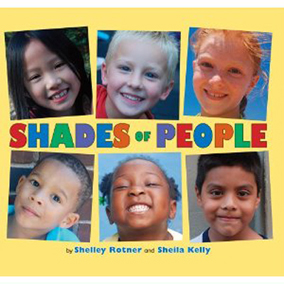
Shades of People by Shelley Rotner and Sheila M. Kelly (2009)
Age: 3-7

First lines: "Have you noticed that people come in many different shades? Not colors, exactly, but shades. There's creamy, ivory, sandy and peach, coffee, cocoa, copper and tan."

A simple concept book with minimal text, naming many shades of skin color, illustrated with dozens of photographs of a wide range of irresistible children's faces.

Central idea: "Our skin is just our covering, like wrapping paper. And, you can't tell what someone is like from the color of their skin."

My take: This is the best overall concept book on skin color I've found. The text is direct and plain-spoken, with no value judgments, no need to sell the concept. (I have a few quibbles with photo choices, text placement, and which colors come first, but these are minor.)

All the Colors of the Earth by Sheila Hamanaka (1994)

Age: 4-7

First lines: "Children come in all the colors of the earth / The roaring browns of bears and soaring eagles, / The whispering golds of late summer grasses, / And crackling russets of fallen leaves, / The tinkling pinks of tiny seashells by the rumbling sea."

A joyous and poetic celebration, "inspired by her own two children's multi-ethnic heritage," of the range of colors in skin and hair, depicted in oil paintings of realistic children in fanciful natural settings. Several spreads show biracial families.

Central idea: "Children come in all the colors of the earth and sky and sea."

My take: This book is an old favorite, exuberant in its appreciation of the beauty of difference, and I love Sheila Hamanaka's tender portraits of children. It may seem too flowery and sentimental for some tastes.

The Colors of Us
by Karen Katz (1999)

Age: 4-8

First lines: "My name is Lena, and I am seven. I am the color of cinnamon. My mom says she could eat me up."

When Lena says that "brown is brown," her artist mother ("the color of French toast") takes her on a walk to find all the colors of brown in their neighborhood. Bold flat color and bright patterns.

Central idea: "Look at everyone's legs, Mom - all the different shades."

My take: The nonfiction-masquerading-as-fiction format is a pet peeve of mine, and the adult neighbors have stereotypical ethnic roles (Mr. Pellegrino makes pizza, Mr. Kashmir "sells many different spices" and has a turban and a curling mustache, and the only dark-skinned black adult, Candy, is a babysitter who "looks like a princess"). The story has a fun ending, with Lena making charming portraits of everyone in "all the colors of us."

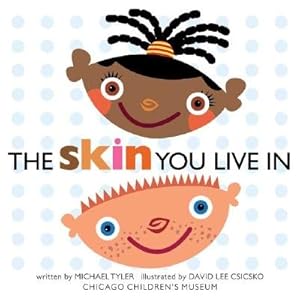
The Skin You Live In
by Michael Tyler, illustrated by David Lee Csicsko (2005)
Age: 4-8

First Lines: "Hey, look at your skin ... The wonderful skin you live in! The skin you're all day in; the skin that you play in; the skin that you snuggle up, cuddle up, lay in."

A rollicking rhyming book about skin, including its variety of colors, produced by the Chicago Children's Museum.

Central Idea: "... the skin you live in, so beautifully holds the 'You' who's within... We all make a beauty, so wonderfully true. We are special and different and just the same, too!"

My take: The text is bouncy, playful and entertaining, with amusing and surprising rhymes ("It's face the rain bold skin and snow-angel cold skin"), good for keeping the attention of a story hour. The references to colors come only in the middle of the book, in the context of what we all have in common.

The art is graphically pleasing but sometimes puzzling in content: almost all children have football-shaped heads with ear knobs on the ends (see cover). The only exceptions are a few faces, particularly the recurring Asian girl (the only Asian character), whose head is rounded with only one ear. Given the topic, it seems odd to set up such a strong pattern and then break it in this random way, bringing to mind the Sesame Street song, "Which of these things is not like the other?"
---
Despite my caveats, I'd use any of these books to start a conversation about skin color and race (and with older children, topics like stereotypes can be part of the discussion).

Got any other recommendations for books that directly address skin color and racial features for children ages 3-8?

(At this point I'm not including books such as Black is Brown is Tan, about a particular biracial family, though of course it could be used to spark a discussion on race; I'm saving it and similar titles for a post about books featuring biracial and multiracial families.)

Race Talk with Young Kids: How to Start

When our Korean-born daughter was four or five, one of her favorite adults was Hyo-Jung, a young Korean-American friend.

At some point during each visit with our daughter, Hyo-Jung would lift a strand of her glossy, straight black hair, then a similar strand of Yunhee's, and sing, "Same hair!" The game never failed to delight Yunhee and I'm sure helped forge a deep bond with this lovely woman who looked like her, as none of her immediate family members did.

Hyo-Jung was simply pointing out the obvious, in a relaxed, playful, affirming tone. For people who've been dealing with race every day of their lives, as many people of color do in the U.S., this might not be a difficult feat; it's an everyday topic.

But research shows that, by some counts, "75% of white families never or almost never talk about race with their children." Obviously, if statistics like that cover your experience, breaching the topic may not come out relaxed, playful, and affirming the first few times. But it's a good standard to reach for.

Here are some first steps for talking about race with very young children:

Start with the assumption that our children DO notice race. Just because they don't appear to based on what they say doesn't mean they're not categorizing. Many studies have documented that children - and even infants as young as four months - detect differences in skin color.

Where in the world did we get the idea that they don't see it? Children are natural sorters. They see, and we teach them, the "green car, pink pig, yellow flower, red ball, brown shirt ..." but all of a sudden when the color is on skin, it's invisible?

Of course, one of the reasons that children don't voice their observations is that the adults around them have given them implicit but clear messages that it's not to be talked about.

Include colors of skin and shapes of features in sorting games, as naturally as referring to the grass, the cat or the ball. Color identification, comparing and contrasting, alike and different ("Same hair!"). That's all that very young children are seeing. Those categorizations don't yet come with the charged complexity or value judgments that older people bring to the topic.Tailor the conversation to children's ages and developmental stages. As with so many other topics, adjust the amount and type of information as children mature, and as needed in response to their questions and comments.

And, picture books are a great way to introduce the topic.

Next up, six titles that can start the conversation.

Further reading:
Here's a terrific short article, "5 Tips for Talking About Racism with Kids," including a Q&A with Dr. Beverly Tatum, president of Spelman College and author of Why Are All the Black Kids Sitting Together in the Cafeteria? And Other Conversations about Race, one of the nation's foremost authorities on racial identity development and race conversations. (My only quibble is that to accurately reflect the content of the piece, the title should say "Race," not "Racism." Talking about racism, though it can overlap, is another topic for another post.)

Monday, April 4, 2011

Noticing Race

Of all the essays in the book Are We Born Racist?, about which I'm writing this series of posts, the one I wish everyone would read is child psychologist Allison Briscoe-Smith's "How to Talk with Kids about Race." (Here is a shorter version, as it originally appeared in "Greater Good" magazine under the title, "Rubbing Off").


We can engage in all kinds of efforts to unlearn, reprogram, override and free our adult minds from the bias we've absorbed, but surely one of the most fruitful and effective applications of the new data about how prejudice is formed is to figure out how to prevent it from forming in our children's minds in the first place.

Briscoe-Smith's advice: Talk about race. She cites studies with babies and toddlers demonstrating that when presented with faces of people of a different race, they gaze longer at them, which is how young children process new information and "suggests that racial difference is salient to them." Various kinds of studies indicate that children of all races notice race much earlier than we think they do, and long before they have the language to voice their observations.

Here's why it's so important to talk about race with children:
1. Children do notice race, and sort people based on it, but without the judgment we adults ascribe to those divisions.
2. If we are silent, awkward or anxious about the issue of race, children begin to absorb our tension, the message that it's something to be avoided.
3. When we fail to give our children language for understanding the differences their brains are already processing, we limit their opportunities to build skills for connecting across race.

And the cycle repeats itself.

For those of us who were never given language to address race, and in fact taught that it was impolite, dangerous or wrong to address it, beginning those conversations with our children can be daunting. Briscoe-Smith suggests practicing with other adults to increase comfort with the subject.

It's worth the effort. First of all, it's good for us as adults. Briscoe-Smith's own research suggests that "children of parents who talked more about race were better able to identify racism when they saw it, and were also more likely to have positive views about ethnic minorities."

Best of all, talking about race can make a big impact in children's attitudes. "A study by Aboud and Anna Beth Doyle took 9-to-11-year-old children who held prejudiced attitudes toward ethnic minorities and placed them with other 9 to 11 year olds who held less biased beliefs. They asked the kids to talk for two minutes about some of the race-based beliefs they had endorsed earlier in the study. The results were remarkable: After these conversations, the high-prejudice kids demonstrated lower prejudice and more tolerance. Given this impact of a two-minute conversation with a peer, imagine what a childhood of conversations with parents could achieve."

Here's more on the topic:
"Talking About Race with Kids" on "Wild Thoughts from Uganda"
"See Baby Discriminate" from a 2009 Newsweek

Next posts, how to talk about race with children, and five picture books that might begin the discussion.