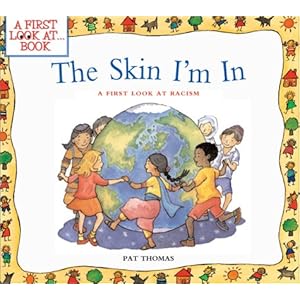
A reader (thanks, Reena) brought this book, The Skin I'm In: A First Look at Racism by Pat Thomas, to my attention. In an Amazon search, it's the only picture book I found that directly mentions racism as the topic of the book.
Age: 4-8
First lines:
page 6
"Imagine a world where only people with blue eyes could go to school. Or a world where only people with brown eyes could get a job."
(Double-page illustration of a classroom full of happy, active children - oddly, all with reddish hair, and all white-skinned except three with brown skin - and a brown-skinned, black-haired teacher. Outside, many sad children - with a variety of skin and hair color and racial features, some dressed in ethnic clothing - look through the window. Eyes are drawn with black dots, so no eye color is visible.)
page 7
"If we lived in a world like this many people would be treated unfairly. They would miss out on the chance to learn and work and feel good about themselves."
page 8
"The way you look is decided by your family background. Sometimes this is called your culture, or race. The most common way race is judged is by the color of your skin." (Illustration of dark-skinned family with curly black hair.)
page 9
"Your race tells the history of your family. It is where your ancestors come from and the religion and traditions your family has followed for many years." (Illustration of Jewish family with yarmulkes and menorah.)
Central idea:
"Some believe that people from their race are worth more and should be treated better than people from other races. A person who thinks and acts this way is called a racist. Racists want to stop people of other races from living, working and learning together. Anybody of any skin color can be a racist."
My take:
This is a well-meaning book in the First Look series, which includes titles on teasing, honesty, death, disability, and other issues, all written by "psychotherapist and counselor" Pat Thomas. The book brings to minds a statement I once heard Native American author Joseph Bruchac make about the book Brother Eagle, Sister Sky: "Its heart is good but its mind is lost." I've quoted more first lines than usual because I wanted to convey the sense of the text, which I find choppy and sometimes incoherent, and the content, some of which is confusing and at times downright misleading. The biggest problems I see are:
1. There is no clear definition of race. The implication that race includes culture, religion and traditions only complicates a topic that is already confusing to children (and adults).
2. The text defines racism as synonymous with individual acts of racial prejudice. There is no attempt to address in-groups and out-groups, and the reality of racism as a pervasive and systemic societal problem, not just people being mean. Granted, tackling this topic for young children in a developmentally-appropriate manner is very challenging, but many kindergarteners have heard the story of Rosa Parks and been exposed to the idea of laws based on race. If only individual attitudes and behaviors are mentioned, it should be called racial prejudice, not racism.
3. The illustrations, though pleasant and appealing, are sometimes more distracting and confusing than illuminating. For instance, the text, "Have you ever been afraid of somebody that looked different from you?" is accompanied by two children (one brown, one white) looking nervously at an adult clown. In addition, as a friend pointed out (thanks, Kim), all the children's features are drawn identically, different only in skin color, hair style and color, and clothing, which seems an exceptionally odd choice for a book about race.
---
The book does have some useful language and ideas: that a trusted adult should always be told when a child encounters racist behavior; that "sometimes racist behavior ... can be hidden in the way people treat each other or talk about each other;" that "Most people want the world to be a place where each of us gets the same opportunities to make friends and to learn and grow." A knowledgeable adult could use portions of the book as the springboard for a discussion with young listeners.
But clearly, we need more books that address the topic of racism for young children.


